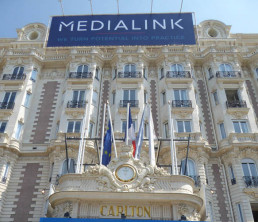
Advertising at its worst.
At its best, Advertising makes the world a better place to be. Its creativity helping to provide some wit, beauty, inspiration, emotion or simple utility that, in some small way, contributes a net positive to our day to day lives.
It’s this kind of work that is celebrated in Cannes each year at the ‘Festival of Creativity’. But it struck me, that while this is supposed to be the zenith of advertising’s creative potential, it has, in its midst, a glaring example of what advertising does at its worst.
The Ritz Carlton Hotel is an icon. Not just of the Cote D’Azur. But of advertising itself. It has featured in many campaigns over the years – Jean Paul Goude’s L’Egoist commercial probably being the most notable. But it is also the architectural centrepiece of the festival. Its ‘Terrace’ a veritable electron-magnet for a, seemingly, endless supply of shameless adfolk whose lack of self-respect knows no bounds if it means securing a dirty, waiter-less table on the heaving, rosé-sodden verandah.
That aside though, it is a beautiful, historic building. One that, during Cannes Week, carries advertising on its striking façade. But far from adding to the world. Making it a better place to be. These ads make it worse. Something akin to those sad, flaccid tarpaulins, limply erected on the brickwork of inner-city pubs promoting ‘Steak and Chips for £5.99’.
This isn’t creativity. It’s pollution. An architectural work of art defaced by our industry during the week that the same industry puts its creative chops on a pedestal.
Of course, an unavoidable truth of advertising is that it nearly always shows up where it’s not wanted: In our living rooms, on our streets, our phones, laptops, even in toilets.
That’s why it’s more important than ever to remind ourselves that we put stuff out into the world. And with that comes great responsibility. Nothing that we put out into the world is neutral. It either enriches the world or it pollutes it.
And let’s face it, there are more ways for advertising to pollute the world now than there has ever been in the history of communication.
The flipside, of course, is that there are also now more ways to enrich it.